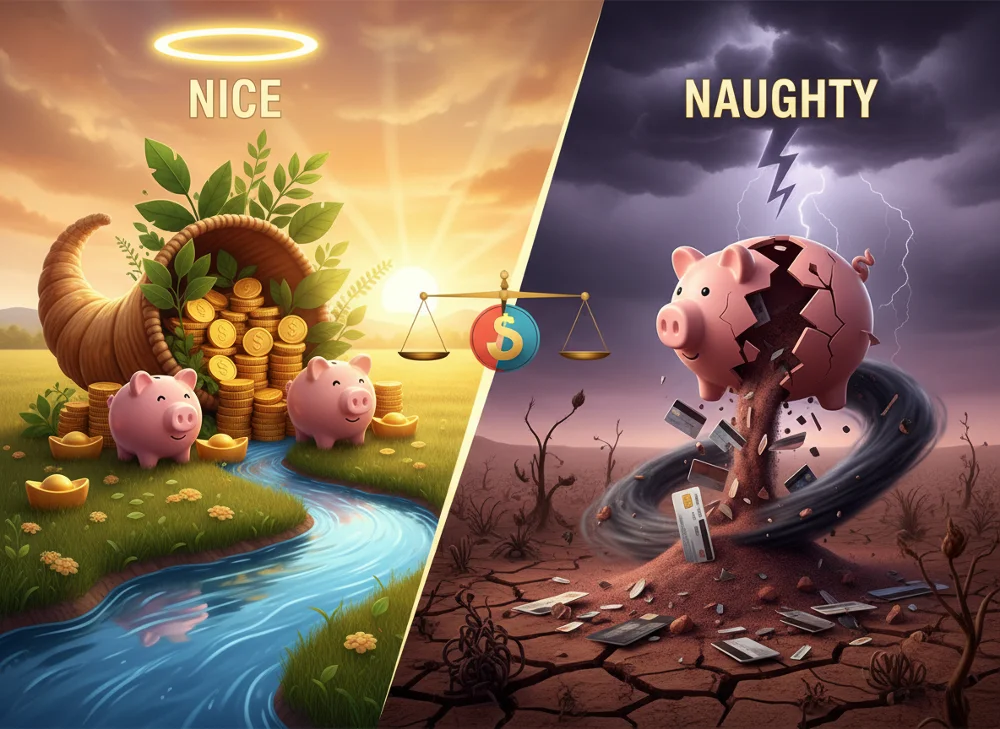
Every January, people promise themselves a better financial year. They vow to save more, spend less, invest smarter, and finally “get serious” about money. Yet by March, most of those promises fade — not because people lack discipline, but because they focus on intentions instead of systems.
As someone who has spent years reviewing real household budgets, bank statements, and financial recovery plans, I’ve noticed a pattern: financial stability isn’t built on dramatic decisions. It’s built on boring, repeatable habits. That’s why entering 2026 with a clear “nice and naughty” list for your finances may be one of the most practical exercises you can do.
This isn’t about moral judgment. It’s about recognizing which behaviors quietly support your financial health — and which ones steadily undermine it.
The Financial “Nice” List for 2026
1. Treating cash flow as a living system
People often look at their finances once a month, sometimes once a year. In 2026, that’s no longer enough. Inflation volatility, subscription creep, and variable energy costs mean your cash flow changes constantly. Those who check weekly — not obsessively, but intentionally — are far more resilient when surprises appear.
2. Building an emergency fund that reflects reality
The old advice of “three months of expenses” sounds tidy, but reality is messier. Freelancers, single-income households, and families with dependents often need six months or more. The nice habit here isn’t the number — it’s revisiting the number annually and adjusting without guilt.
3. Automating savings before lifestyle upgrades
Raises and bonuses are dangerous moments. People rarely feel richer for long because lifestyle inflation quietly absorbs the extra income. The financially “nice” move is to automate savings increases before upgrading anything else. What you never see in your checking account is surprisingly easy to live without.
4. Separating long-term investing from short-term emotions
Markets will fluctuate in 2026 — that’s guaranteed. Successful investors are not those who predict movements, but those who design portfolios they won’t panic over. Automation, diversification, and clear time horizons protect you from your own emotions.
5. Talking openly about money within households
Silence is expensive. Couples and families who schedule regular, calm money conversations tend to avoid crises not because they earn more, but because problems surface early. In 2026, financial transparency isn’t optional — it’s protective.
The Financial “Naughty” List for 2026
1. Using credit cards as income supplements
Credit cards are tools, not paychecks. When they quietly replace insufficient income, the problem compounds invisibly. In 2026, rising interest rates make this habit especially destructive. If balances grow without a clear payoff plan, it’s a warning sign, not a convenience.
2. Ignoring small recurring expenses
People obsess over big purchases while ignoring dozens of small subscriptions, fees, and “just €10” decisions. Over a year, these drain more cash than expected. The naughty habit isn’t subscribing — it’s forgetting what you’ve subscribed to.
3. Chasing trends instead of building strategy
Whether it’s a hot investment, a viral budgeting method, or a new financial app, trend-hopping creates noise. Financial stability comes from consistency, not novelty. In 2026, fewer tools used well will outperform many tools used poorly.
4. Avoiding financial discomfort
Many people delay checking accounts, opening bills, or reviewing debt because it feels unpleasant. Unfortunately, avoidance is one of the most expensive habits in personal finance. Discomfort usually signals an area that needs attention, not avoidance.
5. Expecting motivation to last
Motivation fades. Systems endure. Anyone relying on willpower alone to manage money will struggle. The naughty habit is waiting to “feel ready” instead of building simple, repeatable processes.
A Final Thought for 2026
Financial stability doesn’t require perfection. It requires honesty, structure, and patience. The people who will feel calmer about money at the end of 2026 won’t necessarily be wealthier — they’ll be clearer. Clear about their habits, their limits, and their priorities.
If you’re unsure where to start, begin by writing your own nice and naughty list. Not based on advice columns, but on your real behavior. Money improves fastest when it stops being abstract and starts becoming personal.